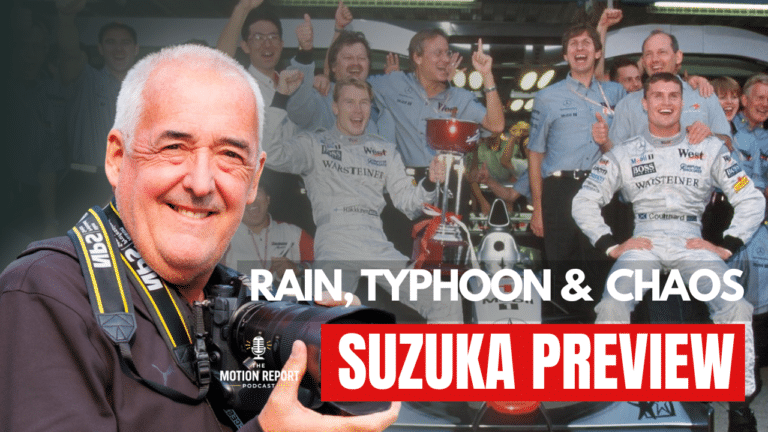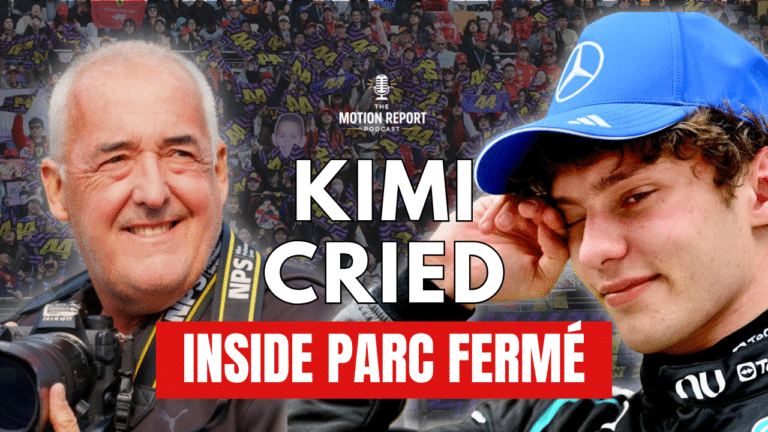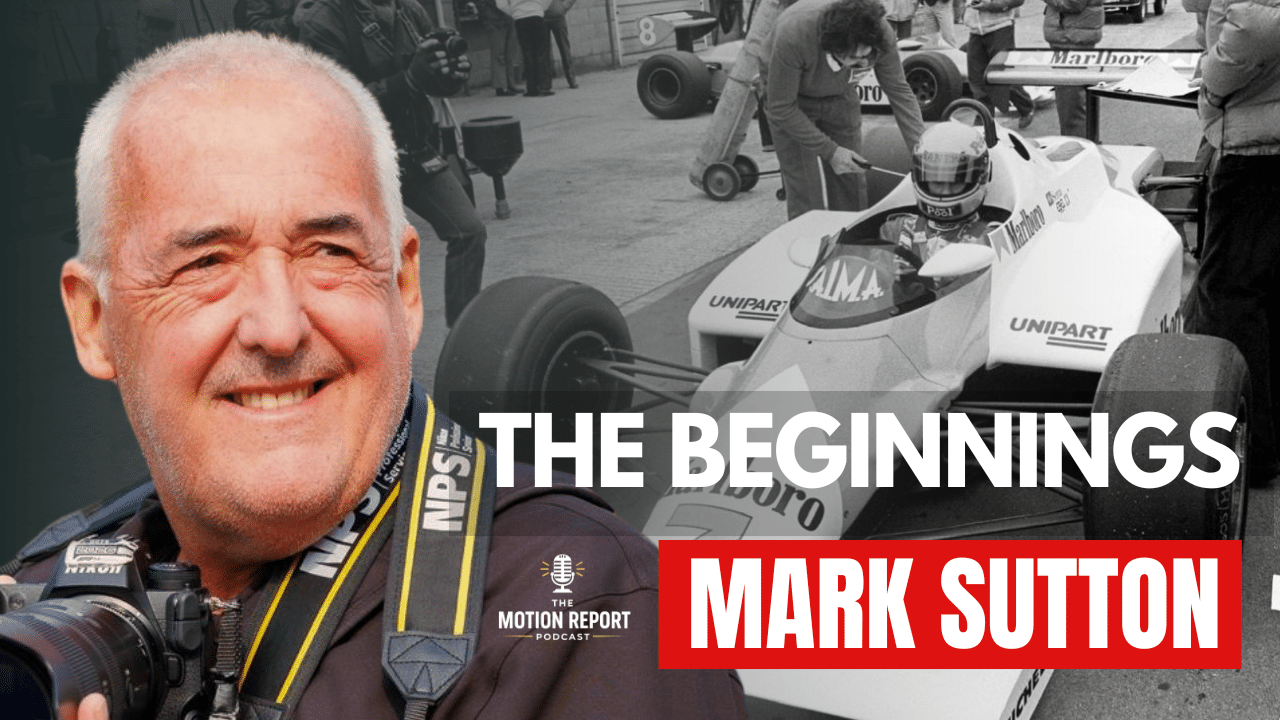
Before there were camera phones, influencers, or TikTok paddock content, there was a young kid from Manchester winding 35mm film at the side of a Formula 1 track, hoping he’d caught the shot. That kid was Mark Sutton, and in Episode 1 of The Motion Report Podcast, he tells the whole story to host David Schneider.
A First Race, and a Crash That Made a Career
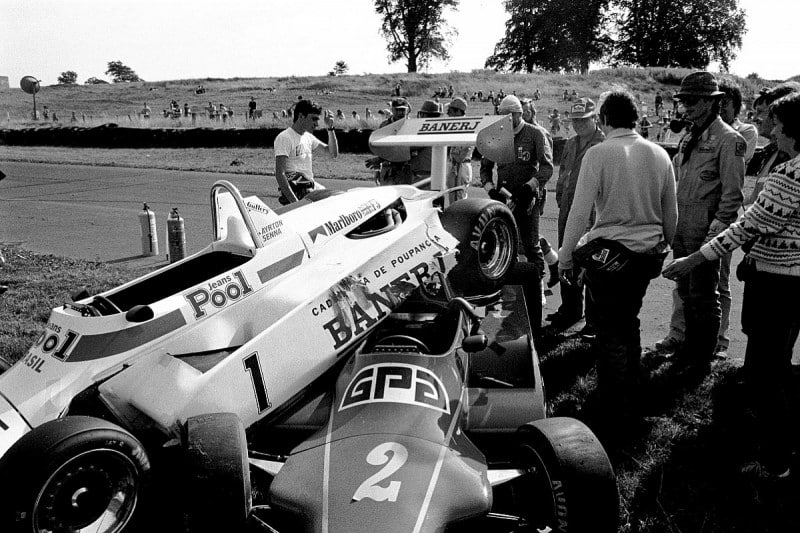
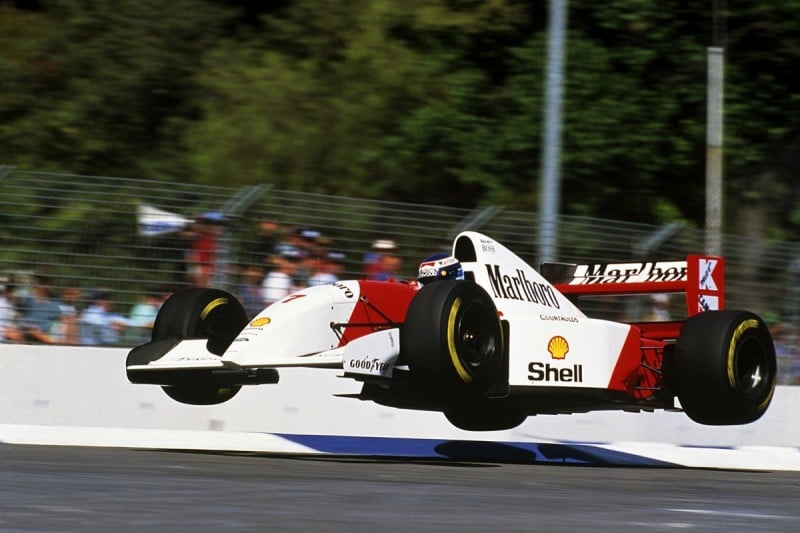
Sutton’s story begins with his father, who took him to races from the age of two at Oulton Park in Manchester, and with his older brother, who became a professional photographer at just 17 and pulled Mark into the darkroom soon after. His first real assignment came in 1983: an 18-year-old Sutton sent to shoot a fierce battle between a young Ayrton Senna and Martin Brundle. Senna dived down the inside, the two cars ended up wheel to wheel, and Senna’s car landed on top of Brundle’s — a startling accident with no halo device and no digital replay to fall back on. Sutton, still winding his manual film camera, missed the impact itself but captured the dramatic aftermath. Those images ran around the world, and a career was born.
Building Sutton Images From a Manchester Darkroom
In 1984 Sutton shot his first official Grand Prix at Brands Hatch, and a year later he and his brother founded Sutton Photographic — later known simply as Sutton Images. In those early years, everything was shot on 35mm film and processed by hand back at the office: loading tanks, mixing chemicals, washing and drying negatives before a single print could be made. It was slow, laborious work by today’s standards, but it taught Sutton the fundamentals of light and exposure that would define his career.
What began as two brothers processing black-and-white film by hand grew, through a contract supplying a Japanese F1 magazine, into an agency of up to six trackside photographers, a 25-person operation with 1.4 million images available online at its peak. Sutton also points out how different access used to be in that era — cars sat uncovered in the pit lane, garages were open, and there was little of the secrecy that now surrounds every component on a modern F1 car. Photography back then was almost entirely editorial, with income coming from magazines and, eventually, lucrative sponsorship work with brands keen to be associated with the sport’s growing television audience.
Some of the agency’s most valuable work came from spotting talent early. Sutton recalls an approach to sponsor a completely unknown driver in Formula Ford, offering free branding on the car in exchange for photography access. That driver was Jenson Button, and the relationship paid off in full when Button — by then a world champion — picked Sutton out of the crowd for a celebratory fist pump in 2009, a moment built on more than two decades of trust between driver and photographer.
By the time Sutton Images was sold to Motorsport Network in 2017, the archive had swelled to roughly 4.5 million photographs from a standing start, later combined with other agencies — including LAT Images and the Rainer Schlegelmilch and Ercole Colombo collections — into a 26-million-image archive covering more than seven decades of motorsport history.
Joining Getty Images
The Motorsport Network archive, including Sutton’s work, was acquired by Getty Images in April 2024. Since 2025, Sutton has worked as a Getty staff photographer — a shift from decades of freelance agency life to a structured operation with HR support, a pension and dedicated wellbeing provisions. Getty’s Formula 1 coverage typically fields around 20 photographers and sales staff at each Grand Prix, working across all 24 races on the calendar.
Front of the Grid: Celebrities, Dignitaries and World Leaders
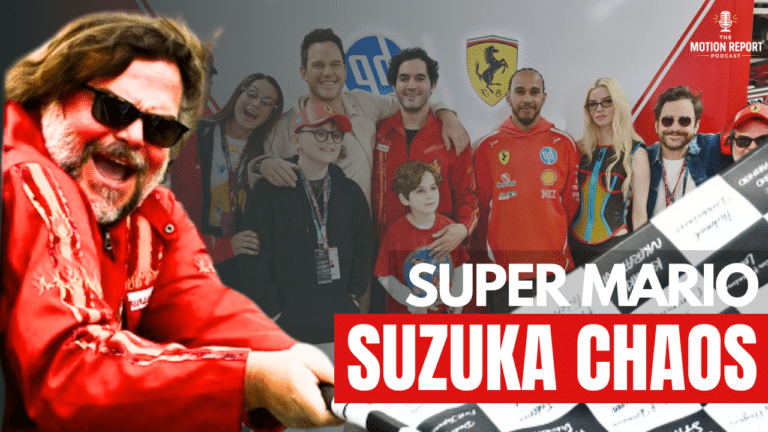
One of the most striking parts of Sutton’s job is his position at the front of the grid during the national anthem, alongside Formula 1 CEO Stefano Domenicali. Only three or four photographers are ever granted this access, positioned closest to the visiting heads of state, sports stars and Hollywood names who now attend races in far greater numbers than in previous decades — usually joined by a photographer from the race promoter and one representing the FIA. Sutton has photographed an enormous range of high-profile guests over the years, from actors and musicians to sitting politicians, and notes that even the performer singing the national anthem can turn out to be a celebrity in their own right.
He also credits Formula 1’s global celebrity appeal — accelerated by Drive to Survive — with reshaping the sport’s fanbase, particularly among younger female fans who now make up close to half the paddock’s audience. Fan photography, he says, has become just as important to Formula 1’s marketing as celebrity access: shots of supporters in branded clothing, draped in flags from every corner of the world, capture just how international the sport’s following has become.
Twenty-Four Races a Year
Despite the travel and the pressure, Sutton is unequivocal that he wouldn’t change a thing. Getty, he says, takes the mental and physical demands of the job seriously — support he didn’t always have running his own agency. Fresh from the Bahrain pre-season tests, he’s already packed for the season-opening Australian Grand Prix, describing a grid that looks unusually close at the front heading into 2026.
In this episode you’ll hear about:
- How Sutton Images went from a dark room in Manchester to 25 staff and 1.4 million photos online
- The early sponsorship deal with a totally unknown driver called Jenson Button — and how that decision paid off in 2009
- What it’s actually like to photograph world leaders, Hollywood celebrities and F1 champions from just metres away at the front of the grid
- The mental and physical demands of 24 race weekends a year — and why Mark genuinely wouldn’t change a thing
- What he saw at the Bahrain pre-season tests that has him pumped for 2026
This is the first episode of a long-form series dedicated to the people behind the F1 lens — and there is genuinely no better place to start than here.
🎧 Listen on iTunes / Spotify | ▶️ Watch the full episode on YouTube
The Motion Report is an FIA media-accredited Formula 1 journalism channel. Subscribe for weekly paddock reports, technical analysis, and in-depth podcast conversations throughout the 2026 season.
Follow Mark on Instagram
https://www.instagram.com/f1sutton/
Read More
- Australian Grand Prix 2026 Preview: New Era Begins at Albert Park
- F1 Power Rankings 2026: Upper Midfield and Title Contenders Before the Australian Grand Prix
- F1 Power Rankings Before the Australian Grand Prix 2026: The Bottom
- Bahrain Final Day of Testing 2026: Mercedes Set the Standard as Aston Martin Face Melbourne Concern