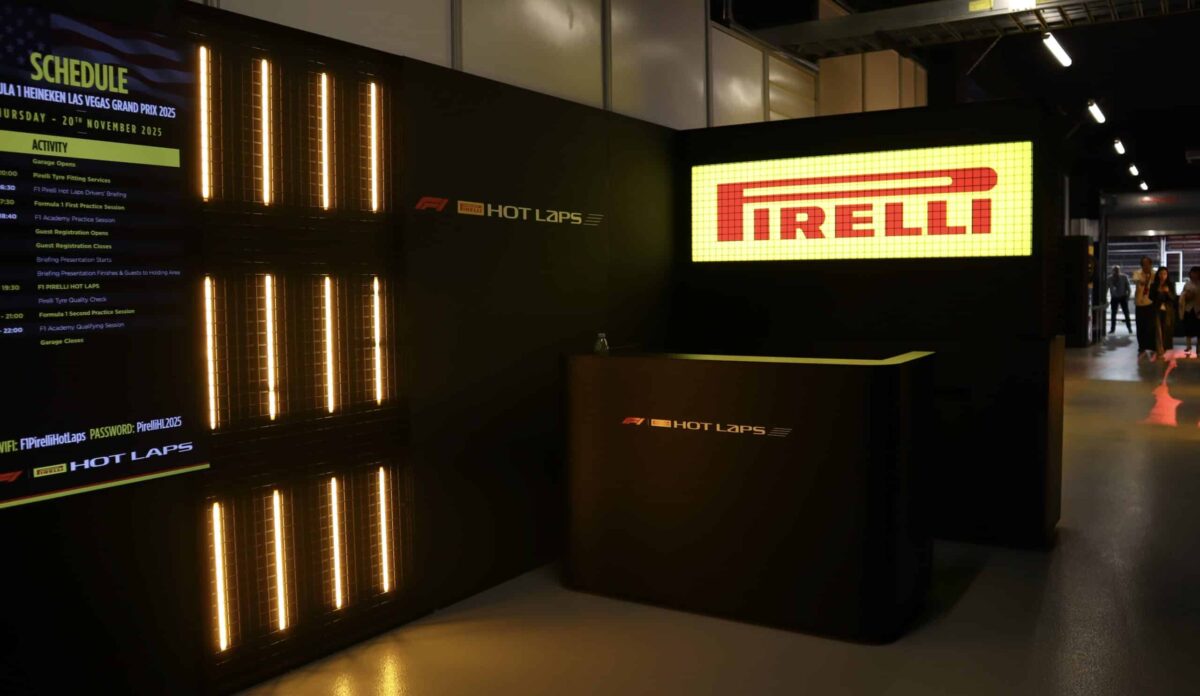
What does it actually feel like to barrel through the Las Vegas Strip at 155 mph, pinned to your seat by G-forces, with neon lights smearing past your window? We went inside Pirelli’s elite Hot Laps program at the Las Vegas Grand Prix to find out — and the driver behind the wheel was not who we expected.
What Is Pirelli Hot Laps? F1’s Most Exclusive Ride Experience Explained
The Las Vegas Grand Prix has always been F1’s most theatrical event. But in 2025, amid the glitz of celebrity sightings — Beyoncé, Jay-Z, Travis Scott, and Ben Affleck all made appearances in the paddock — it was an experience that happened off the main stage that stood out most.
Pirelli Hot Laps is the official F1 tire supplier’s VIP passenger ride program, running at select rounds throughout the season. Guests buckle into a high-performance road car fitted with Pirelli’s racing slick tires and are taken around the actual Grand Prix circuit — at actual speed. It is, without question, one of the most visceral ways to understand what Formula 1 drivers experience every single race weekend.
This is not a gentle sightseeing lap. This is 155 mph on public roads that were open to traffic just hours before.
The Car: Ford Mustang Dark Horse With 500 Horsepower
For the 2025 Las Vegas GP, Pirelli selected the Ford Mustang Dark Horse as the Hot Laps vehicle — a naturally aspirated V8 producing approximately 500 horsepower. On a street circuit that rewards power delivery and braking precision over aerodynamic downforce, the Dark Horse was a fitting choice.
The moment the V8 fires, you understand immediately why this machine was chosen. The exhaust note isn’t background noise — it’s a physical presence that vibrates inside your chest. Before you’ve even cleared the garage lane, the car feels alive in a way that road cars rarely do.
Pirelli’s racing slick tires, fitted to a road-legal platform, provide grip levels that simply aren’t accessible in normal driving. The result is an experience that sits in a strange and thrilling middle ground: faster than anything most people will ever experience on public roads, yet far slower than the 200+ mph Formula 1 cars that would be racing on this same tarmac 24 hours later.
The Driver: Frankie Muniz Is a Real Racing Driver Now
Here is where the Las Vegas Grand Prix being Las Vegas asserts itself.
After the pre-lap safety briefing from Pirelli’s team, after the helmet fitting, after being walked out to the grid — the driver who climbed into the Dark Horse and offered a handshake was Frankie Muniz.
Yes, that Frankie Muniz. The child actor best known for Malcolm in the Middle. Now 40 years old, and a working NASCAR competitor.
His racing career is not a celebrity vanity project. Muniz has been competing seriously in NASCAR’s lower series for several years, accumulating genuine race craft and car control. Behind the wheel on the Las Vegas circuit, that was immediately evident. His inputs were smooth and deliberate, his braking points precise, and his communication with a terrified passenger — this reporter — impressively calm.
“Hey, I’m Frankie. Nice to meet you,” he said, as if he does this every day. In Las Vegas, at an F1 Grand Prix, apparently he does.
<!– YOUTUBE VIDEO PLACEHOLDER: Frankie Muniz interview / Hot Laps driver feature — embed here –> <!– [INSERT YOUTUBE VIDEO: Frankie Muniz on NASCAR, F1 & Pirelli Hot Laps | The Motion Report] –>
What 155 MPH on the Las Vegas Strip Actually Feels Like
The first thing Muniz asked: “What’s the fastest you’ve ever gone in a car?”
When the honest answer is “no idea,” he smiled. “Don’t worry. We’ll take it easy.” Then he braked — hard — for absolutely no reason, just to establish context. The seatbelt loaded up, the nose dipped, and the car’s kinetic energy transferred directly into your understanding of what braking at race speed actually means. Point made.
The Strip section is where the experience moves from impressive to genuinely disorienting. As the Dark Horse accelerates down Las Vegas Boulevard, the shift changes are physical — each upshift pushes you deeper into the seat. The speedometer climbs past 150 mph, the neon lights of the casinos becoming long horizontal streaks in your peripheral vision. The gauges read approximately 250 km/h (155 mph).
Then the braking zone for Turn 14 arrives.
Pirelli’s racing slicks load up with spectacular grip, but the road surface tells a different story. This is still a street circuit, meaning it is — or recently was — public infrastructure. The bumps through the Turn 12-14 complex are jarring in a way television never conveys. The car hops slightly over asphalt seams, and you feel the tire working to maintain contact with each micro-undulation. The vertical G-forces through this section hit your abdomen and head, not just your back — a reminder that F1 circuits are not smooth.
The width of the Strip is deceptive. From a spectator’s view, the race track looks enormous. At 155 mph with barriers, grandstands, and street lighting encroaching on your peripheral vision, it feels much narrower. The brain’s natural speed-calibration breaks down entirely.
The Race Circuit That’s Also a Public Road: What TV Doesn’t Show You
One of the defining characteristics of the Las Vegas Grand Prix circuit — and one that is genuinely hard to appreciate from broadcast coverage — is that the track is also an active city street.
The circuit remains partially open to public traffic during the race weekend on a rotating schedule. That means the surface doesn’t receive the full preparation of a purpose-built facility. Maintenance crews inspect and prepare the track, but the underlying texture of the asphalt — the joins, the municipal patches, the real-world wear — remains.
This is particularly pronounced through the Turn 12-14 braking complex, where the combination of surface roughness and the repeated violent deceleration creates handling demands that simply don’t exist on smooth permanent circuits. Miss the optimal line through here, and the car becomes unsettled in a way that rewards caution and punishes aggression.
For Formula 1 cars, with their extraordinary suspension systems and active aerodynamics, this is managed. For a 500-horsepower road car on slick tires, it is a continuous, tactile conversation between driver and surface.
Hamilton, Beyoncé, and the Culture of the Hot Laps Program
<!– YOUTUBE VIDEO PLACEHOLDER: Lewis Hamilton Hot Laps with Beyoncé — embed here –> <!– [INSERT YOUTUBE VIDEO: Lewis Hamilton Pirelli Hot Laps Las Vegas GP | The Motion Report] –>
The passenger experience isn’t the whole story of Pirelli Hot Laps in Las Vegas.
On race day itself, Lewis Hamilton served as the program’s special guest driver — and his passengers included Beyoncé, Jay-Z, and Travis Scott. The images of Hamilton at the wheel of the Hot Laps car with the world’s biggest music stars aboard circulated globally, becoming one of the defining visual moments of the entire 2025 Las Vegas GP weekend.
This is precisely what Pirelli has built the program to be: a bridge between Formula 1 as a motorsport and Formula 1 as a cultural force. The Hot Laps experience functions simultaneously as a premium VIP product, a marketing platform for Pirelli’s tire technology, and a demonstration that the speed and sensation of F1 is something that can be shared — however briefly — with people far beyond the paddock.
The Netflix series Formula 1: Drive to Survive and the Brad Pitt-led F1 film have brought unprecedented new audiences to the sport. Las Vegas, with its built-in global entertainment infrastructure, is where F1’s sporting identity and its pop-culture moment collide most visibly. Hot Laps is the embodiment of that collision.
What Pirelli Hot Laps Teaches You About F1 Drivers

Formula 1 coverage has never been better. Onboard cameras are extraordinary. Commentary is more technical and sophisticated than ever. Data visualization tools let fans track tire degradation in real time.
And yet.
Nothing in broadcast television prepares you for the deceleration from 155 mph into a street circuit chicane. The sensation of the seatbelt loading against your chest, the nose of the car diving, the horizon lurching — these are things the vestibular system understands only through direct experience.
Pirelli’s slick tires provide lateral grip in cornering that feels, to a first-time passenger, almost like the laws of physics are being suspended. The body expects the car to understeer, to push wide, to do something other than track the intended line with complete fidelity. When it doesn’t — when the front end simply bites and holds — the cognitive disorientation is significant.
For an F1 driver, this sensation exists at twice the speed, under far greater aerodynamic loads, in a car with vastly superior mechanical grip, for 50+ laps. What the Hot Laps experience ultimately provides is not a simulation of that. It’s a reference point — a physical vocabulary — that makes the real achievement of what those drivers do every weekend comprehensible in a way that watching never quite manages.
Key Takeaways: Pirelli Hot Laps Las Vegas GP 2025
- The vehicle: Ford Mustang Dark Horse, V8, ~500 hp, fitted with Pirelli racing slick tires
- The circuit: Las Vegas Grand Prix street circuit, including the full Strip acceleration zone
- Top speed experienced: Approximately 250 km/h (155 mph)
- Guest driver for VIP session: Frankie Muniz (actor, NASCAR competitor)
- Race day special driver: Lewis Hamilton (with Beyoncé, Jay-Z, Travis Scott as passengers)
- The standout section: Turn 12-14 complex — bumpy, physical, demanding, nothing like it looks on TV
- What it teaches you: That F1 drivers are operating in a physical environment that broadcast can describe but never fully convey
How to Experience Pirelli Hot Laps
Pirelli Hot Laps runs at selected Formula 1 Grand Prix events throughout the season. Access is typically through official F1 hospitality packages, Pirelli partner programs, and select media accreditation. Availability varies by event.
For the Las Vegas Grand Prix specifically, the program is among the most sought-after experiences in the F1 calendar — a function of the circuit’s layout, the city’s entertainment infrastructure, and the unique cultural weight that Las Vegas carries in the modern F1 era.
The Motion Report covers Formula 1 with full FIA paddock accreditation across all 24 rounds of the season. For more F1 analysis, paddock access content, and investigative reporting, subscribe to The Motion Report on YouTube.
Contributor:山口 京香 Kai Yamaguchi
Read More
- Pirelli Marks 500 Grands Prix with a Landmark Book
- Monaco 2026: Five Things You Need to Know Before Lights Out in Monte Carlo
- Mercedes Dominate 2026 Canadian Grand Prix as Antonelli Claims Fourth Consecutive Victory
- The Rumour That Gripped the F1 Paddock
- Franco Colapinto Claims Career-Best P6 in Canada as Alpine Momentum Builds